One of the best things about getting married was the day we unpacked our books onto a single shared bookshelf. We didn’t have a single book in common, which depending on how you look at things bodes well, or is a bad omen.
One of my husband’s books catches my eye every week as I sit in my studio and teach weekend lessons, even though I’ve never picked it up off the shelf to read it. “Lies My Teacher Told Me,” by James W. Loewen doesn’t have anything to do with the clarinet. The title though, gets me thinking.
There are phrases that I catch myself saying in my most sleep deprived, distracted and least effective days as a teacher. They are really awful phrases. Where do they come from? They come from my own teachers, things they said on their most tired days. So, I propose to address some of them here and devise simple, easily repeatable substitutions that are actually helpful to clarinet students.
Let’s start with the worst: “Push your air harder.” Ugh. Where do I begin about how awful this is? It’s royally unhelpful. At best, it’s just too general. At worst, it encourages forcing and tension. There are so many great substitutions I can’t list them all here so I’ll just cherry pick my favorite: “Aim your fast air forward.” I love this because it’s a call to action that’s specific. It encourages thoughtful blowing rather than brute force. It describes the air (fast) and gives a direction (forward), and the verb “aim” takes care of shape (focused). In addition, if this phrase ever crosses your mind, careful assessment of the student’s aperture should come first. If they’re teeth are too close together, no amount of pushing will create a larger more resonant tone.
Related to the above is “put more mouthpiece in your mouth.” While a lot of students do actually need this, most of my students need to start first with aligning their teeth properly. If they simply push in more mouthpiece, effectively moving both the top AND bottom teeth down, this isn’t achieved. Instead I say “slide your bottom lip and teeth together down the reed, closer to the ligature.” This helps with aperture, and a lot of students will immediately make a freer more open sound. You end up with the alignment on the right instead of the left.
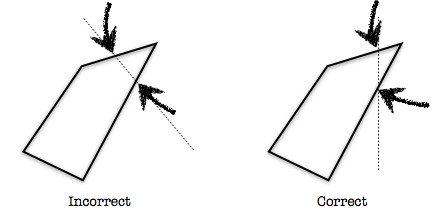
The next one is really pervasive: “Flatten your chin.” And I guess it can be useful as a quick reminder, yet I find it rarely solves anything. Problem is, most kids who struggle with a flat chin simply don’t have the muscle structure needed or there is a defect elsewhere preventing a flat chin. Identifying the cause of their bunching is key, and then replace that terrible phrase with a solution. For instance lack of muscle in the chin: “Firm your top lip onto your teeth” (my teacher Julie DeRoche used to say “hold these teeth with your top lip,” pointing to her lateral incisors). It’s easier to feel and see the top lip when playing, and try to firm it and keep your chin mushy. That is a feat. If the student is bunching from grabbing the mouthpiece with with their lips because the instrument is not stabilized try this: “Steer the clarinet with you right arm.” If the problem is a lack of air support (which will force them to put pressure on the reed), try the phrase in the previous paragraph. All of these phrases are more specific and provide actual solutions. But the crux of it is: teaching proper embouchure is much more complex than our go to phrase to correct it, and as a teacher we have to be careful and specific in diagnosing problems and proposing solutions.
“Keep your fingers close”, or it’s cousin “no flying fingers!” It’s so easy to get this phrase out of your vocabulary that if you’re looking down right now, don’t worry! The simple solution, is to say “Move from the back knuckle ONLY.” or “maintain a 3-way arch,’” which is what my colleague Dr. Dawn Lindblade-Evans says. Actually she has a lot of cute ways to get students to focus on the SHAPE and MOTION of the fingers, which is truly where their flying fingers are originating from.
The next one hurts, because we all say it. “Don’t rush.” This one I’ve actually been mostly effective at eliminating from my teach vocabulary. But when I pull out my old solo scores from college I’m horrified by how often I wrote it in my own parts. It took real intention to eliminate a phrase that was obviously my “go-to.” Again, the focus should be on solutions. A simple reminder to “subdivide” is immeasurably superior. How about “listen to the trumpets” or “take time.” Anything but the word “don’t” followed by what you’re trying not to do!
“Stopped staccato” is a phrase that I only recently replaced. Dr. Lindblade-Evans and I were discussing the fear reaction we get to that terminology from non-single reed playing band directors and we decided to rename it from here on out to “continuous air staccato.” Like most of the phrases I’ve proposed here it’s lengthier but more accurately describes the technique. If our starting point is a flawed name for the technique, I have low hopes that it will be implemented properly by both students and teachers. Continuous air staccato emphasizes to the student that you never stop blowing for this style of articulation, and increases their attention toward when they feel themselves decompressing between staccato notes.
There are many more, I could go on all day. What are your worst phrases, or the phrases you remember being the most ineffective for you as a student? We must be careful with the information we’re choosing to pass on to the next generations of potential teachers. I don’t expect to be perfect, but I expect to get close. A daily gentle reminder of what works and what doesn’t helps me get closer to that goal.
 Julie A. Linder
Leave a comment